OPC UA integration

Connecting meters, PLCs and plant equipment over OPC UA, managed from the platform: endpoint, security, authentication, sampling interval and variable mapping.

Take the data from where it already is

The OPC UA Administration module works in both directions, and that is what makes it unusual. As a client, EVA-Smart AI connects to equipment that already exists — meters, PLCs, drives, control systems — because almost all modern plant equipment speaks OPC UA, the industrial interoperability standard defined in IEC 62541.

As a server, it publishes its own measurements for other systems to consume: a SCADA, a historian or an MES can read from EVA-Smart AI with no bespoke integration. The address space exposes 28 variables per measurement point — voltage, current, power, energy and quality — organised by company, load center and point.

Each client connection is managed separately, with its endpoint, security mode, credentials and read interval. The mapping defines which variable on the remote server corresponds to which measurement point inside the platform.

Each connection's status is visible from the same screen: if a link drops, you see it there — not when the data is missing from a report weeks later.

What each connection manages

  • Its own server: port, refresh rate and the published address space
  • The remote OPC UA server endpoint URL
  • Communication security mode
  • Authentication method
  • Sampling interval
  • Variable mapping to measurement points
  • Connection status and whether it is enabled

Why it matters

Without integration, each data source lives on its own island and consolidation ends up as manual spreadsheet work.
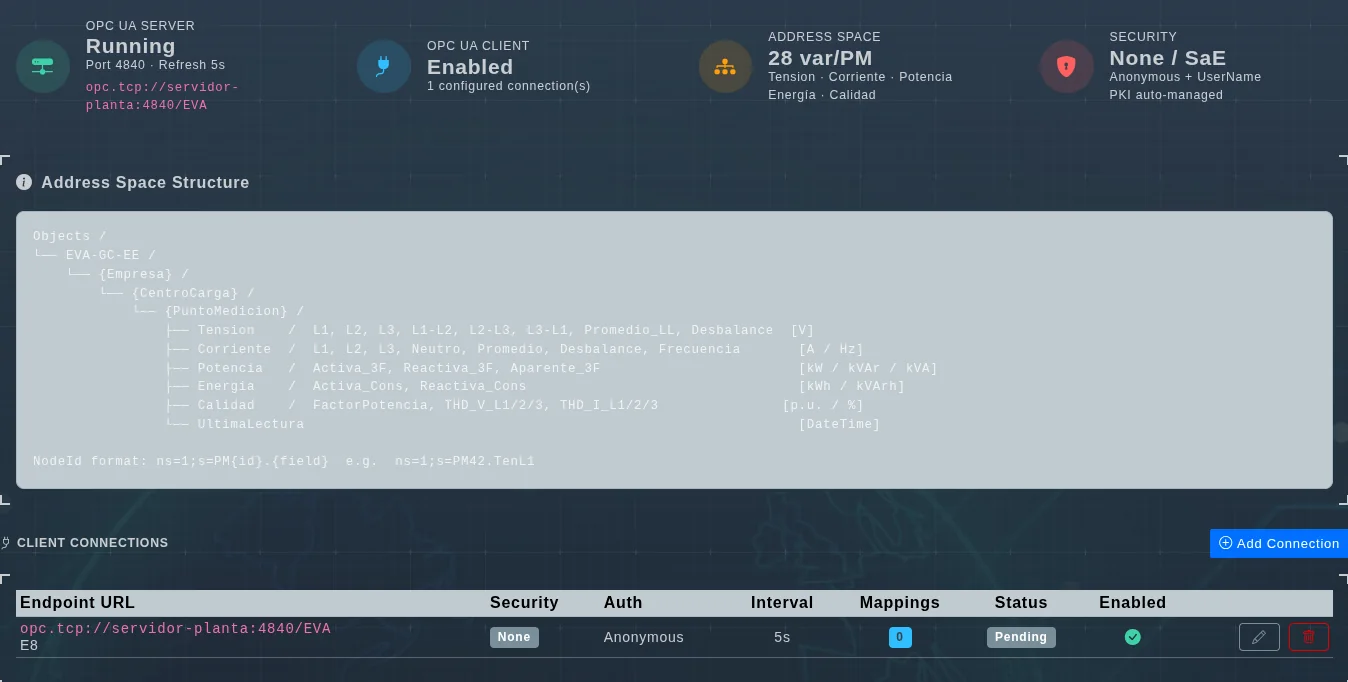
EVA-Smart AI OPC UA administration with server, client, address space and connections
OPC UA server and client on one screen, with the address space EVA-Smart AI publishes: 28 variables per measurement point, organised by company, load center and point, with its NodeId format.

What it enables

  • Reuse existing metering: if meters are already installed, there is no need to duplicate them.
  • Consolidate multi-site: different plants with different equipment in one view.
  • Bring in process variables: not only electrical ones, but whatever the equipment exposes.
  • Enable or disable per connection: without touching the rest of the configuration.

What it avoids

  • A parallel instrumentation project for something already measured.
  • Manual data consolidation across plants.
  • Being locked to a single metering vendor.
  • Finding out late that a link had been down for weeks.

Which equipment do you want to integrate?

Let's review what metering you already have and what can be reused over OPC UA without duplicating investment.

Let's talk about your integration