Savings opportunities

The module that turns consumption history into a list of concrete opportunities, scoped by period, aggregation and measurement point.

From the curve to the action

The Energy Efficient Strategy module analyses the period's behaviour to point out where savings are available: consumption with no production behind it, base loads higher than they should be, or points drifting from the rest.

The analysis is scoped by period, aggregation and substation, so the search can be done plant by plant rather than over an aggregate that hides the detail.

The chosen aggregation changes what you see: a long window reveals persistent base loads; a short one, avoidable peaks and start-ups.

What it looks for

  • Consumption with no productive counterpart
  • Base load outside working hours
  • Measurement points drifting from their peers
  • Consumption concentrated in expensive windows
  • Repeated behaviour open to correction

How the analysis is scoped

Three controls define what the opportunity search runs over.

Controls

  • Period: the historical range analysed.
  • Aggregation: the accumulation window.
  • Substation: the scope of the analysis.

What it enables

  • Build a measure portfolio prioritised by estimated saving.
  • Justify an investment with measured avoidable consumption, not assumptions.
  • Focus the team's effort on the points with most headroom.
  • Verify afterwards whether the measure delivered what it promised.

Quantified savings opportunities

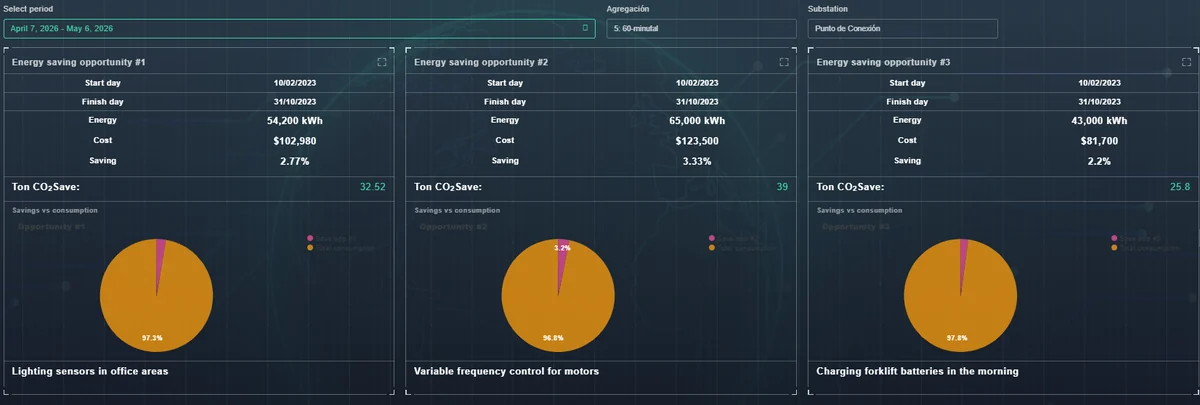
The Energy efficient strategy – Savings opportunities module does more than describe consumption: it identifies specific opportunities, quantifies them and attaches a recommendation.

What each opportunity reports

  • Energy — energy associated with the opportunity (kWh).
  • Cost — electrical cost of that energy, using the Load Centre's tariff scheme.
  • Saving — estimated saving percentage.
  • Ton CO₂ Save — tonnes of CO₂ avoidable by implementing the action.
  • A Savings vs consumption chart and the evaluated period.
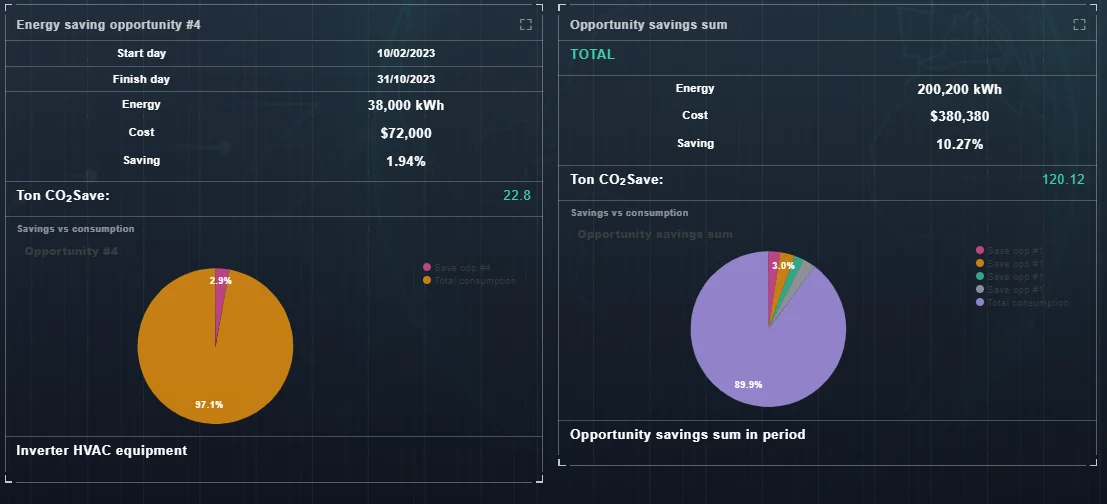
A closing block consolidates the period: total energy, total cost, total estimated saving and total CO₂ reduction.

The recommendations it produces

Each opportunity ends in a concrete action, classifiable as investment (CAPEX) or as a change in operation and energy discipline (OPEX):

  • Lighting sensors in office areas.
  • Variable frequency control (VFD) for motors.
  • Charging forklift batteries in the morning.
  • Inverters on HVAC equipment.
Energy savings opportunities
Savings opportunities with energy, cost, saving percentage and avoidable tonnes of CO₂.
Total sum of savings opportunities
Consolidated sum of opportunities for the analysed period.

Find your savings opportunities

Book an EVA-Smart AI demo over your plant's real history.

Request a demo